


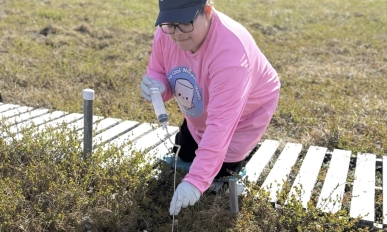
When most people hear the phrase dream team, they imagine a group of extraordinary individuals working together toward a common goal. The funny thing is that in our Arctic Long Term Ecological Research (LTER) aquatic team, the Dream Team is actually a box. Yes. A box. Not a sleek, high tech Arctic research instrument. Not
The Role of Climate Variability in Controlling Arctic Ecosystem Function: A LTER Project
The objectives of the Arctic Long Term Ecological Research (LTER) project are to understand how climate variability ranks as a driver of changes in ecosystem function (e.g., carbon balance) relative to the mean trends from climate change. Within this overall framework, one of the questions the team is asking is how does climate variability affect carbon dynamics along the terrestrial-aquatic continuum? Specifically, how does variability in hydrology (e.g., precipitation) control the degradation of dissolved organic matter in soils from hillslope to valley bottom? The research will use synthesis of ongoing, long-term observations and experiments, and new activities combining observations, experiments, and modeling. These activities will answer the research questions about how trends in mean climate, climate variability, and disturbances all interact to control arctic ecosystem structure and function, now and in the future.
Participants Involved in This Project

Rose Cory | Researcher Fellow
University of Michigan | Ann Arbor, MI
From the Blog
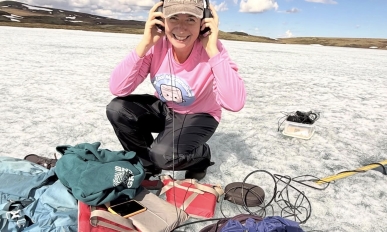
Before traveling to the Alaskan Arctic, I expected to learn about carbon cycling, aquatic ecosystems, and cutting edge ecological research. I did not expect to learn how to listen to the Earth. Yet that is exactly what happened when I had the opportunity to work alongside artist Nikki Lindt and experience her project, Subterranean Voice.


Made possible with funding by the U.S. National Science Foundation Award #2221990. The information contained here is those of the author(s) and does not necessarily reflect the views of the U.S. National Science Foundation.
Sign Up to Receive Updates
Receive regular updates to your inbox with the latest information about the Polar STEAM program.
Get Email Updates