

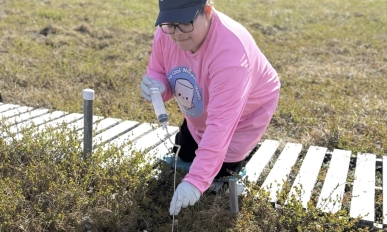
When most people hear the phrase dream team, they imagine a group of extraordinary individuals working together toward a common goal. The funny thing is that in our Arctic Long Term Ecological Research (LTER) aquatic team, the Dream Team is actually a box. Yes. A box. Not a sleek, high tech Arctic research instrument. Not
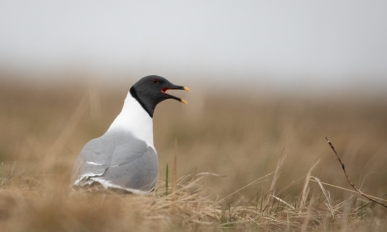
Connection Points Interconnectivity has been a recurring theme surrounding this entire experience. What happens in the tundra does not exclusively impact the tundra; it affects us all. The terrestrial, freshwater, and marine ecosystems found there cascade their influence all over the world in various ways. Migration patterns of birds, fish, marine mammals depends on the
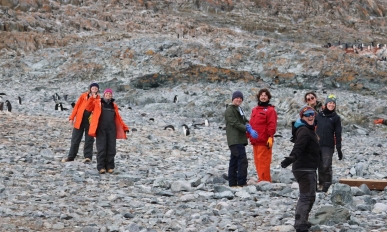
The oceanography world is a small one. For such a massive force covering the majority of the planet, the team of scientists that study it is relatively small. Meaning, even though the scientists gathered aboard this vessel are from all different institutions across varying coastal cities studying all different specialties, they all know someone who
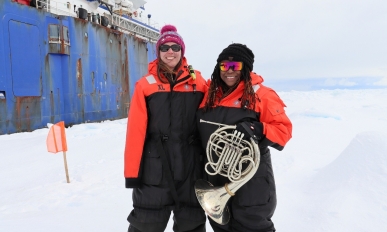
I had opportunities to collaborate with artists on research projects I conducted in the United States, but never on an international expedition to Antarctica. As a polar plankton ecologist, I participated in six research expeditions to Antarctica and know how intense they can be. They are certainly not for everyone given the long working hours, sometimes cramped conditions, and tumultuous seas. In speaking with Kyra prior to the cruise, I could already tell she would be amenable to working in Antarctica.
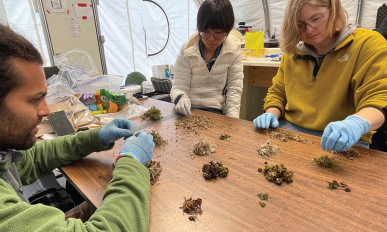
My journey starts at Toolik Field Station (TFS), a research station located 370 miles north of Fairbanks, Alaska at Toolik Lake with an interdisciplinary group of Co-Principle Investigators (Co-PIs) and graduate students from three different institutions. As Arctic permafrost thaws, carbon that has been sequestered, or frozen in the ground for thousands of years, can
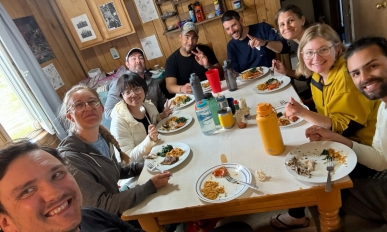
I miss my new family. Don’t get me wrong—I love my family at home very much. This adventure would not have been possible without the support of my wife and daughter. But I also miss the new family I found in the Arctic. I traveled north to conduct field research, to participate in a science
We started Sunday with a team ritual: reading poems aloud. Some were fun, some serious, all genuine. Afterward came “call-outs,” where team members recognized each other’s efforts, followed by a weather update—crucial for planning fieldwork in the Arctic. These routines, carried out without fuss, reflected how much intention goes into maintaining a strong team culture.
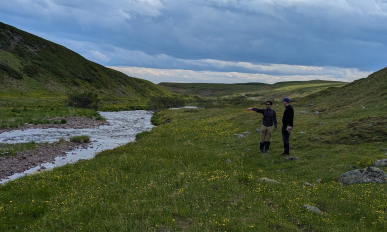
“Do you think they do delivery?” Aleksey asks with a grin as he looks back at our last boxes of cookies. For the past nine days, we’ve been camped out in a Reindeer police cabin in the Varanger Peninsula in northeastern Norway. This is our first cool evening of the trip, and the mosquito net-wrapped windows are coated with what we’ve been calling “yr,” the Norwegian word for mist.
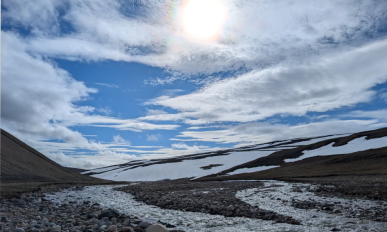
I thought I had seen all of the colors of blue before my trip to the Far North. After all, I teach about the electromagnetic spectrum and the active and passive sensors that scientists use to understand our changing planet. And yet. There were blues in Kalaallit Nunaat that I had never seen before. While photographs don’t really capture the vibrancy of the colors, or the feeling of being there, they are a starting point for conveying what I mean.
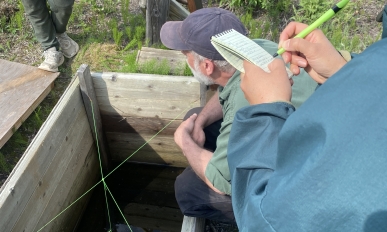
Our plane glides through the Endicott Mountains of the Brooks Range as we make our final descent into Anaqtuuvak. Accessible only by plane, Anaktuvuk Pass (“the place of caribou droppings”) is located 250 miles northwest of Fairbanks and is home to the only community of inland Iñupiat, Nunamiut, people [1]. Below, icy blue glaciers feed into a winding network of streams that snake through dense, green tundra and low-lying willows that line the banks of the Anaktuvuk River. From the air, the tundra is a verdant forest, but once on the ground the trees and shrubbery are no taller than 5-6 feet. The village stands out like a colorful flower within the greenery, blooming into view as we enter the valley. In Anaktuvuk, the roots of plants and people alike extend down into permafrost, the lifeblood of the ecosystem and holder of history.
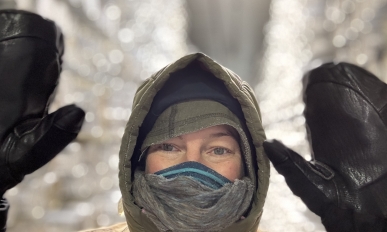
As a high school science teacher, I’m always looking for ways to inspire my students with real-world science and deepen their understanding of our planet. The PolarSTEAM Educator Fellowship has been an extraordinary opportunity to merge my passion for polar environments with my teaching. Through this year-long virtual collaboration with T.J. Fudge, a research scientist at the University of Washington, I’ve been immersed in cutting-edge research on ice cores, allowing me to bring current polar science research to my students.



Made possible with funding by the U.S. National Science Foundation Award #2221990. The information contained here is those of the author(s) and does not necessarily reflect the views of the U.S. National Science Foundation.
Sign Up to Receive Updates
Receive regular updates to your inbox with the latest information about the Polar STEAM program.
Get Email Updates