
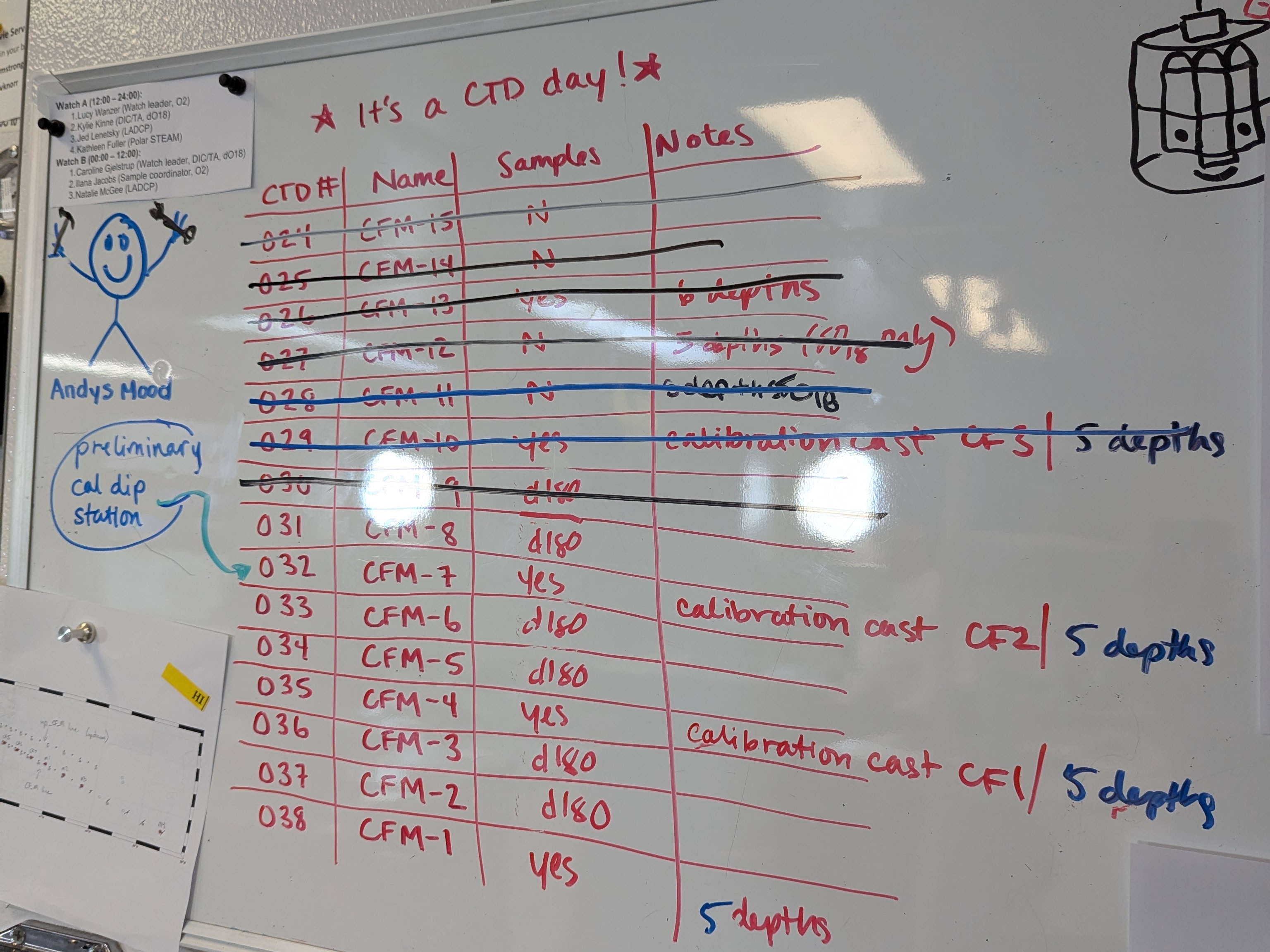
The first thing most of us do upon waking up is check the infamous “board of lies.” This whiteboard is used to communicate the planned schedule of events for the day as well as other important updates. However, it can and does frequently change due to scheduling, weather, wind, waves, and other unforeseen factors, hence the name.
On day 9 of the cruise I opened a browser tab on my phone to see a livestream of the board. I wanted to know what kind of day I had in front of me for my upcoming 12 hour shift before leaving the comfort of my bunk. I anticipated a few CTD casts and long transits between stations as that is what I had come to expect from the days prior. Instead I was met with a list of seemingly endless CTD casts.
After “breakfast” (aka lunch as I wake up at 10 am to start my shift at noon) my team transitioned to the lab to start attacking the list. Foul weather gear and steel toe boots on, hard hats and life vests fastened, radio in hand, we make our way through the water tight door onto the deck.
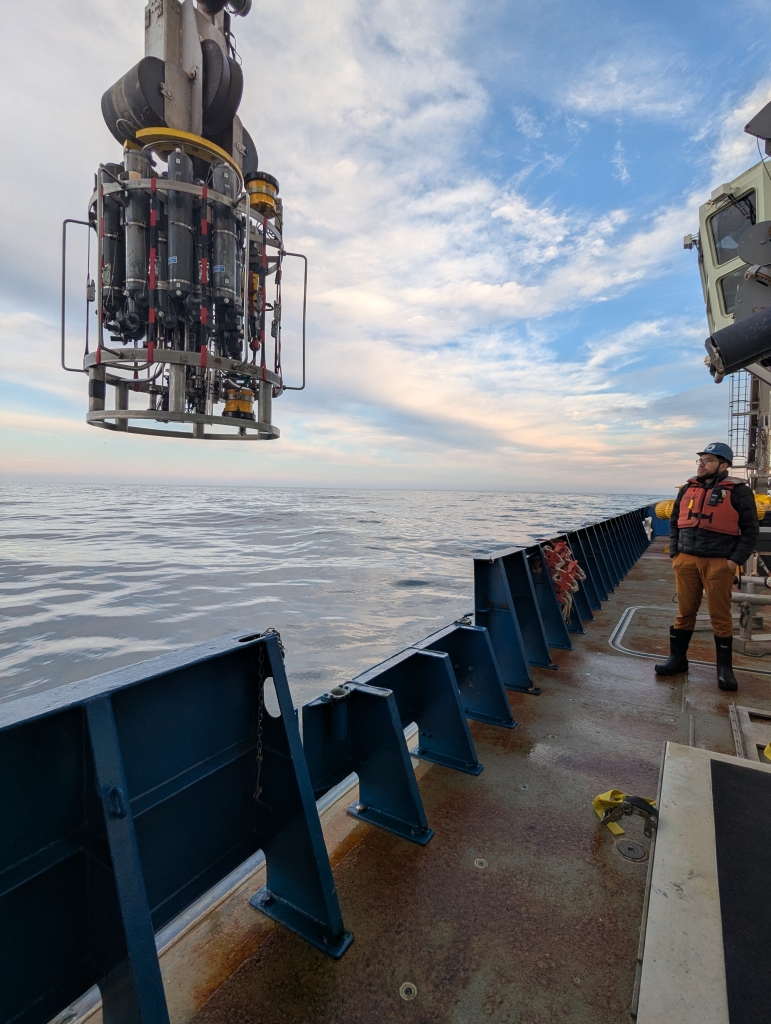
“Bridge – Deck – Permission to unstrap CTD.”
“Go ahead.”
Four yellow, salt water soaked straps are freed from their ratchets. The safety chain comes down.
“Winch – Deck – CTD is ready to deploy.”
“Copy”
The rosette is hoisted into the air, extended over the surface, and lowered under water.
Back in the lab, boot up software, enter in key details, power up the system, determine bottom depth.
“Winch – Lab – Bottom depth is 184 meters, wire out to 154 meters.”
CTD moves through the water column. We watch the screen as live data comes in and monitor to ensure we do not strike the seafloor.
The rosette reaches its target depth. Calculations are made. Graphs are observed. A sampling plan is designed.
“Winch – Lab – New target wire out 105 meters.”
“Copy”
The rosette rises to and stops at pre-determined depths. Bottles are closed. Calibration is underway.
The cast is complete.
CTD is recovered and four yellow, salt water soaked straps are re-secured in their ratchets.
“Bridge – Deck – we are ready to get underway.”
This intricate dance repeats again, and again, and again until we complete a record breaking 17 casts in the span of 12 hours. In between each cast there is no real chance for a break as this time is spent water sampling, updating log sheets, and preparing the rosette to be redeployed at the next stop.
Thankfully my team has developed a strong method of teamwork.
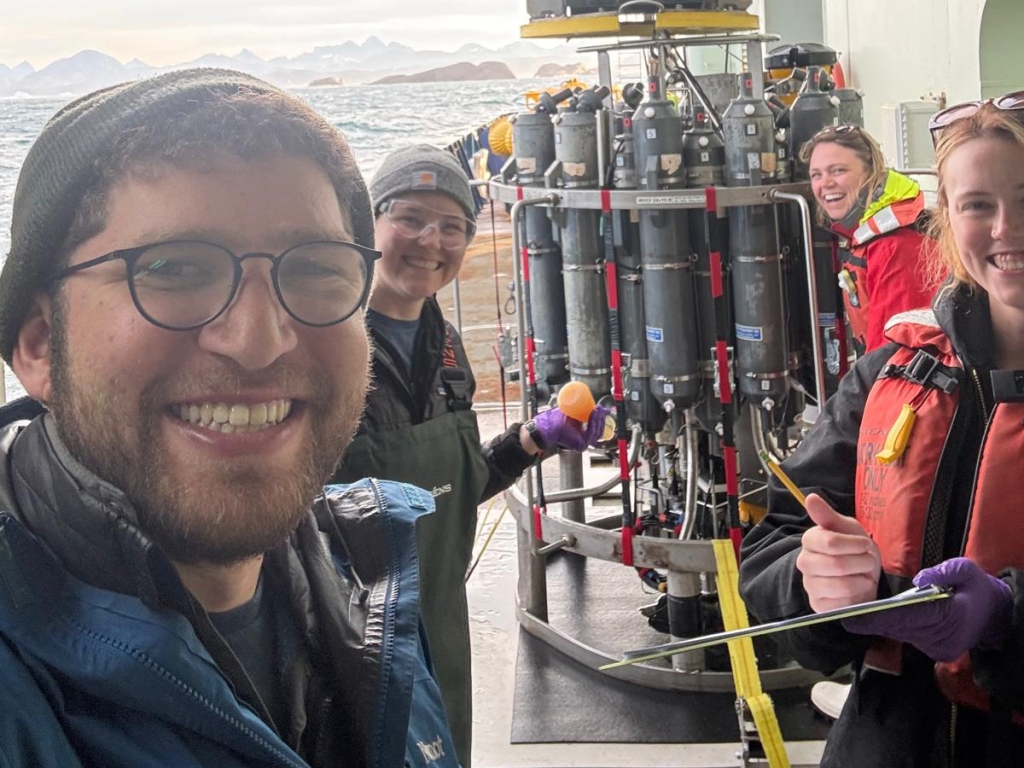
Kylie is our bottle cop – reading numbers, directing bodies, and repeating back values, orchestrating us from her clipboard. Lucy temps the water and fills flasks that will be sampled for dissolved oxygen. Jed follows close behind, filling DIC/TA bottles which he hands off to me, purple nitrile gloves on, to poison with mercuric chloride. Lucy makes a second lap, this time with small screw top vials to be filled and tested for oxygen isotopes. Finally Jed and I, shoulder to shoulder, undertake the final lap to fill yet another type of bottle to be tested for salts. After we fill, treat, and close four unique types of glass containers, we haul everything back inside the lab, re-secure all boxes, then return to the deck to prepare the rosette for yet another trip to the bottom of the ocean.
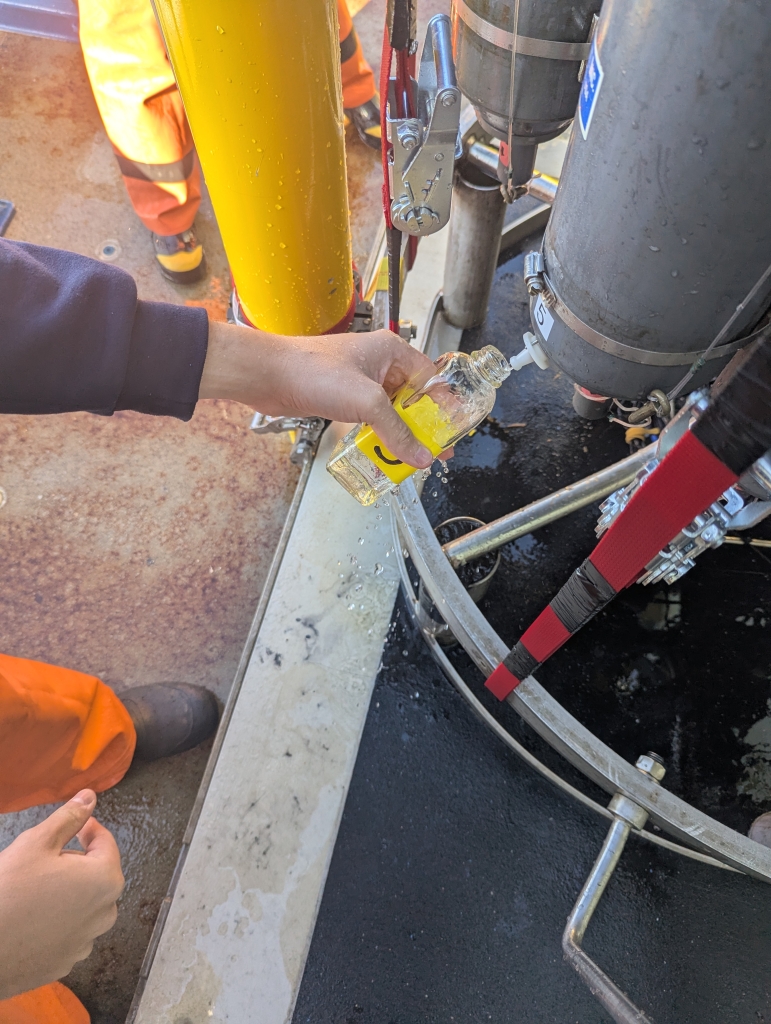
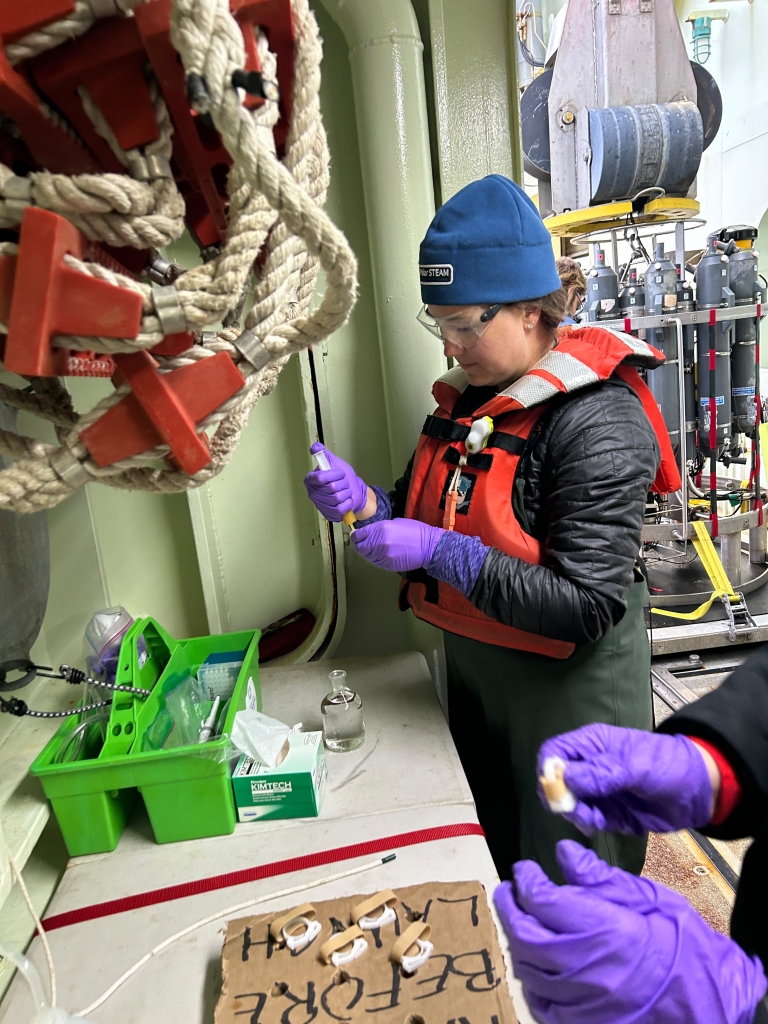
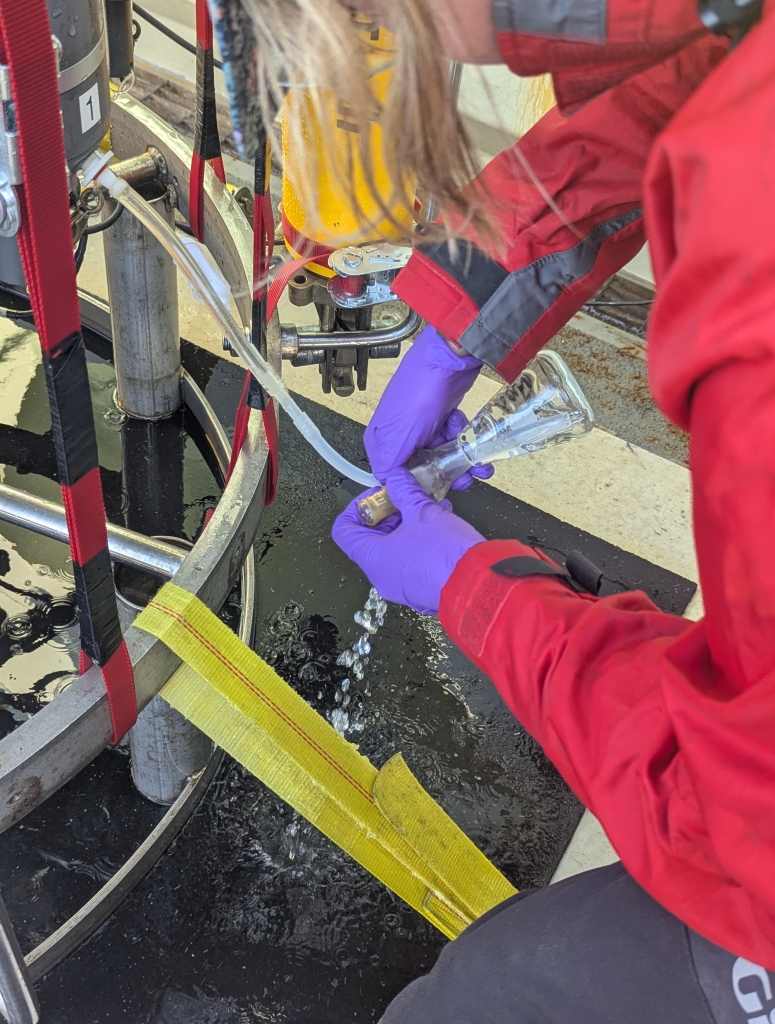
Empty niskin bottles of residual sea water.
Reconnect sensors.
Flush the system.
Cock the bottles open so they can be remotely closed while under water.
All of this is happening while the boat is moving through the water and waves to the next station. We are lucky if we complete our sampling and prepping dance before they arrive.
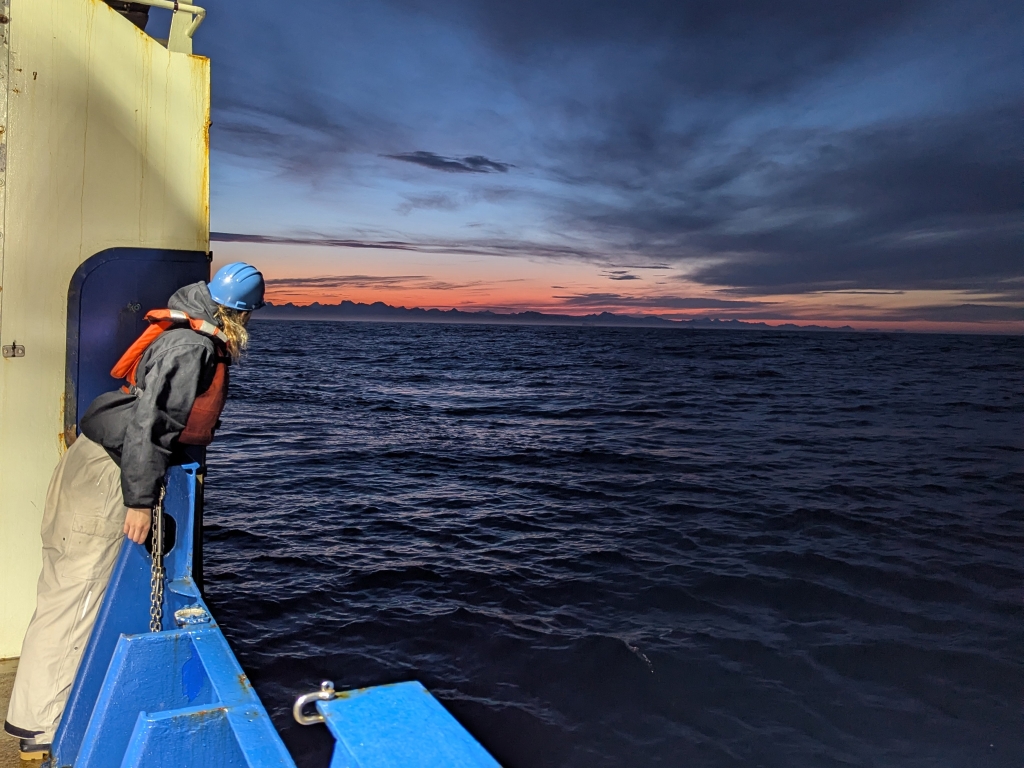
All too soon, we are back on deck, foul weather gear and steel toed boots still on, hardhats and lifejackets refastened, radio back in hand. “Bridge – Deck – permission to unstrap CTD.”