
When my daughter was seven, Frozen II played on repeat in our house. Somewhere between the hundredth rendition of Into the Unknown and our kitchen singalongs, the song became part of our lives.
Before I left for Prudhoe Bay, Alaska, we talked about my trip. Now fourteen, she wanted to know if it would be cold, if there would be bears, and where I would sleep. Most of my answers were simple.
“I don’t know. Maybe. I’m not quite sure.”
Then she asked, “Are you scared, Mom?”
Scared of what?
“The unknown.”
That one word transported me back to teaching science from my kitchen during COVID while she belted out Into the Unknown in the next room.
The unknown is scary. But it’s also where the best things happen.
At 45, I still get scared. Not of bears or the cold, but of not being good enough. After 24 years in the classroom, I was stepping into the world of Arctic research alongside oceanographers and geoscientists using equipment I had only read about. I wondered if I would belong.
Getting to Prudhoe Bay tested that mindset. A 50-hour journey filled with delays, cancellations, missed landings, and very little sleep had me wondering if I would ever arrive. I finally joined the team in a restaurant in Seattle while we all waited for our flights to Anchorage to be rescheduled.
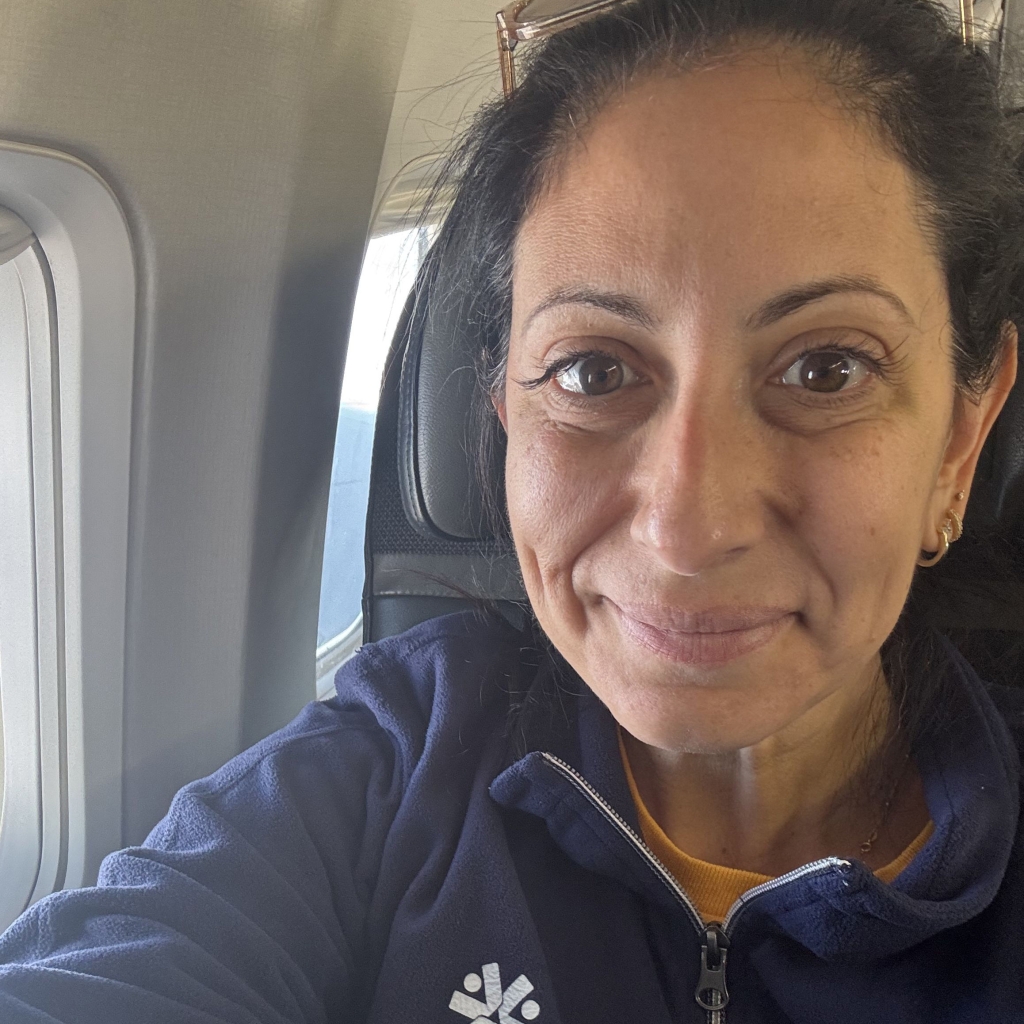
I wasn’t traveling alone anymore. I was part of a team.
While we bonded over East Coast roots and pancakes, I became more blown away by the brilliance of these scientists as they casually chatted about groundwater between bites of toast.
The team I was joining was part of a larger research effort led by Julia Guimond of Woods Hole Oceanographic Institution. Their work focused on understanding how saltwater is moving into Arctic freshwater systems and what that means for the tundra. They were studying the connections between coastal flooding, permafrost thaw, groundwater, vegetation, and the chemistry of soil and water. By measuring salinity, water chemistry, carbon flux, thaw depth, and other indicators across the landscape, they were working to understand how saltwater intrusion may alter Arctic freshwater systems and tundra ecosystems in a warming Arctic.
Alongside Julia were Julia Holtzer of the Marine Biological Laboratory, Alina Spera, a postdoctoral investigator at WHOI, and Kaj Lynoe of the Woodwell Climate Research Center. Each brought different expertise and perspectives to a complex question:
What happens when the ocean begins moving inland?
The next leg of the trip wasn’t any easier. Twice, our plane from Anchorage descended toward Prudhoe Bay, and twice we climbed back into the clouds.
Arctic weather.
When we finally landed, exhausted and relieved, we had reached the unknown we had worked so hard to get to.
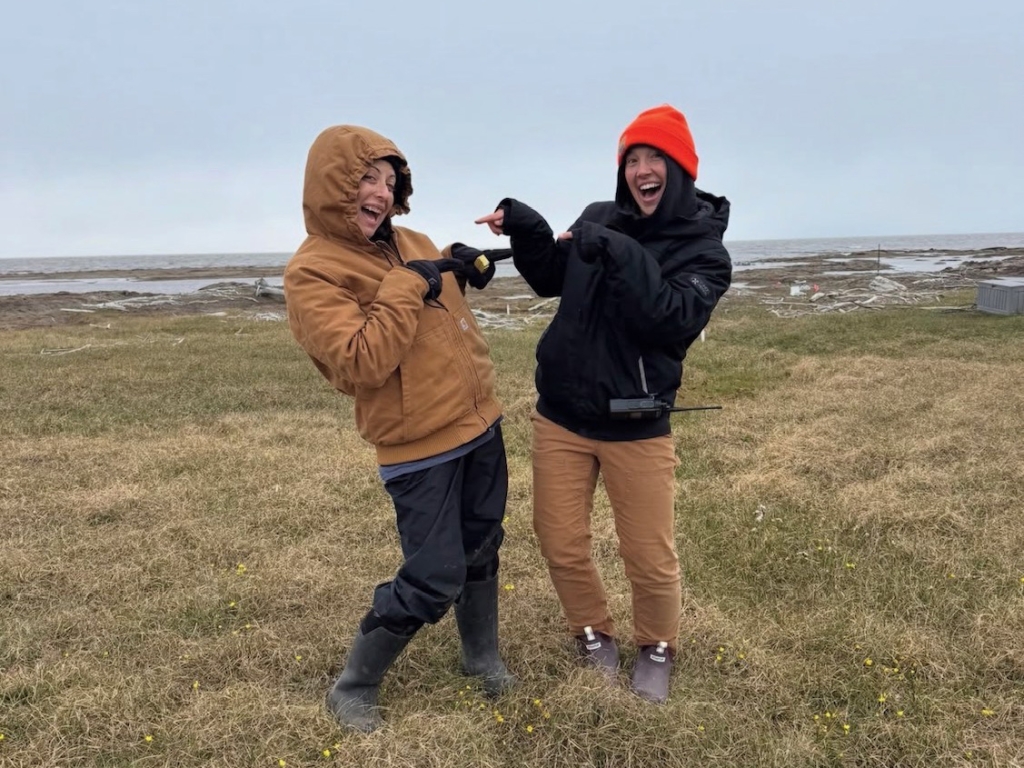
Within hours, we were standing on the tundra.
The scientists moved effortlessly through their routines, speaking a language of research that seemed completely foreign to me. Conversations bounced between calibration, flux chambers, hyperspectral imaging, and pore water sampling. Instruments were unpacked, batteries charged, and data sheets reviewed. Everyone knew exactly where to be and what to do. But while the landscape took my breath away, I couldn’t shake the feeling that I didn’t belong there. I didn’t know what to say. I didn’t know what to ask.
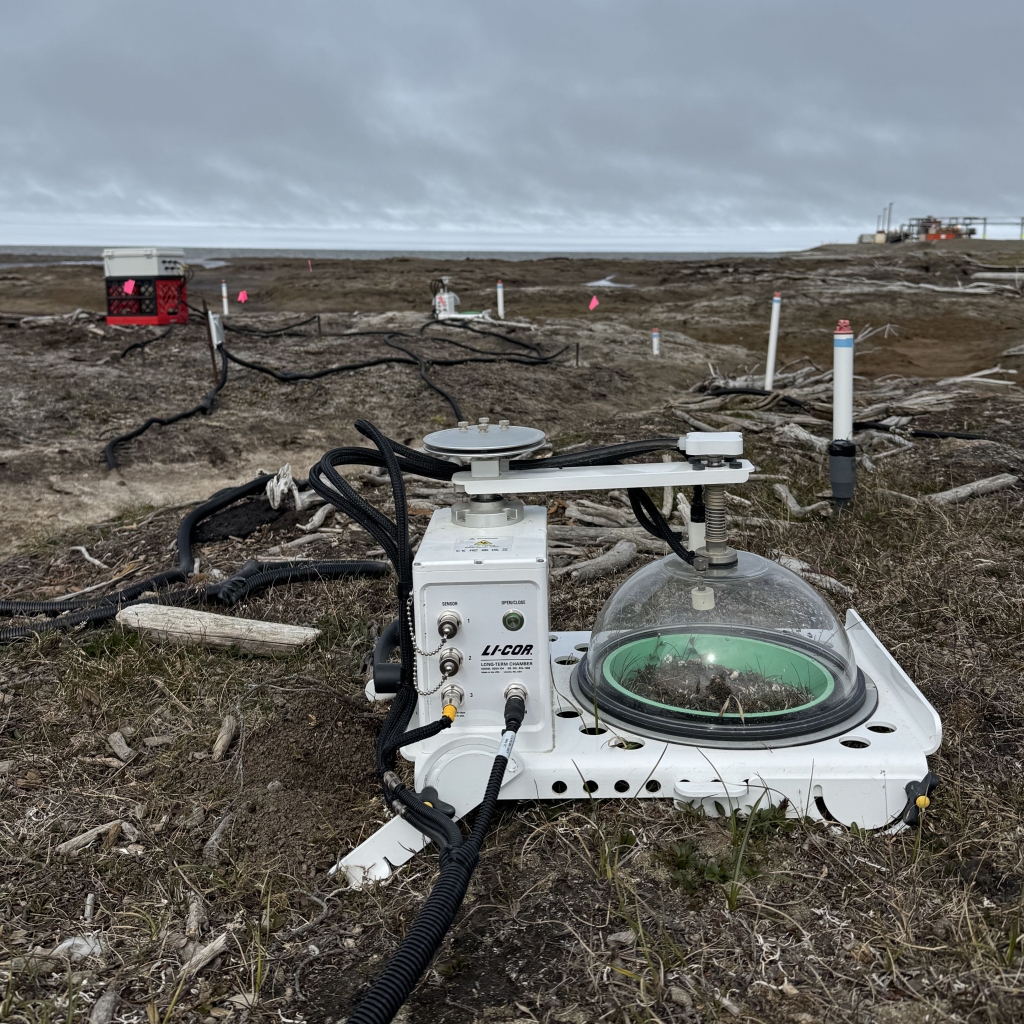
I wasn’t an oceanographer or a geoscientist. I hadn’t published papers or spent years conducting Arctic field research. I was a science teacher from New Jersey stepping into a world I had only experienced through textbooks and journal articles.
While the team was beginning their work, Julia asked if I had any questions.
I was wide-eyed, overwhelmed, and frankly scared by how much I didn’t know.
“I don’t know what to ask yet,” I admitted.
Julia smiled and said, “I’m so glad you’re here.”
Those words stayed with me.
For a while, I watched more than I participated. I listened. I learned. I reminded myself that every expert had once been a beginner.
Finally, I took a deep breath and asked my first question.
“Can I help with that?”
Everything changed.
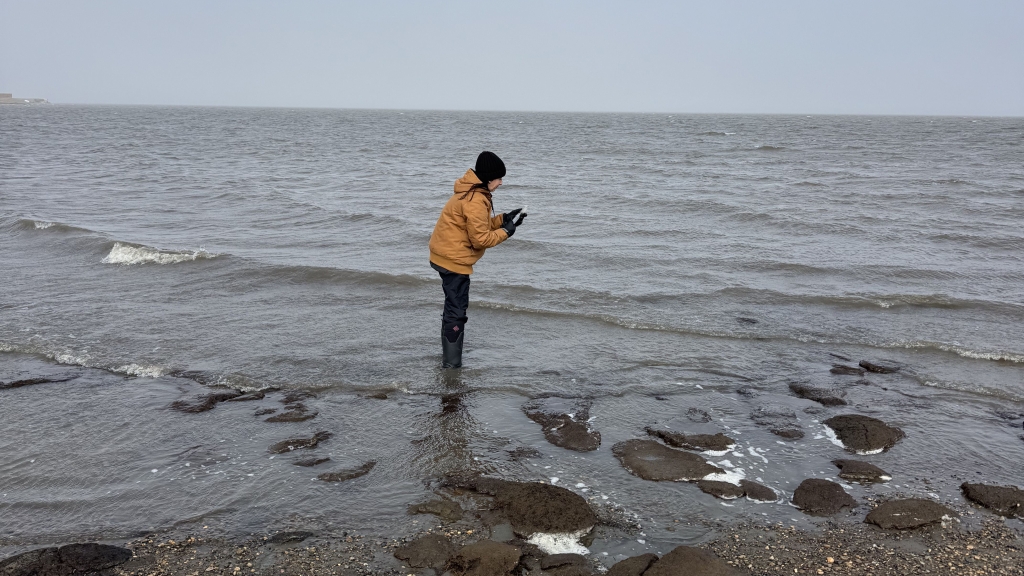
Over the next eleven days, I stopped worrying about what I didn’t know and focused on learning. I learned how researchers use Real-Time Kinematic GPS, hyperspectral cameras, flux chambers, and water-quality instruments to understand how saltwater intrusion is reshaping the tundra. More importantly, I learned how science really happens—not in isolation, but through collaboration, patience, and countless small tasks that come together to answer big questions.
By the end of the week, the language of research no longer felt foreign. I wasn’t just watching the science; I was part of it.
But the important thing is that the team never made me feel like an outsider. Quite the opposite. They welcomed me with patience, kindness, and a genuine excitement to share their work. Once the dam broke, they answered my endless questions, explained their processes, and treated me like a valued member of the team from the very beginning.
The doubt came from me.
And perhaps that was one of the most important things I learned.
I may not have published scientific papers, but I’ve spent my career helping create future scientists. I’ve taught students to love the ocean, to see beauty in horseshoe crabs, to understand ecosystems, genetics, and forensics, and, most importantly, to stay curious.
Suddenly, I realized I wasn’t there despite being a teacher.
I was there because I was one.
This journey changed my perspective on the Arctic, on scientific research, and on myself. Sometimes the greatest lessons happen when we step outside the classroom and become students again. Working alongside an extraordinary team reminded me that every dataset tells part of a larger story, and every person brings a valuable perspective to that story.
I came home with new skills, unforgettable memories, and a notebook full of ideas for my students. But the greatest lesson wasn’t about permafrost, saltwater intrusion, or field techniques.
It was about courage.
Be afraid of the unknown.
Then go anyway.
Because the best educators never stop learning, and sometimes the most meaningful journeys begin when we take one step into the unknown.