

Summary
This Polar STEAM music resource is for upper elementary and middle school general music classrooms. It contains three songs about the South Pole Telescope in Antarctica that can be sung by young people and educators. Extension activities include reading the sheet music to play the songs with Boom Whackers™, on the recorder, performing these songs at a school concert, creating poetry or rap lyrics about the Polar STEAM content. The creative writing activities may be done individually or as a student centered collaborative exercise.
Materials and Preparation
To sing the songs: Sheet music for teacher and students, classroom audio/visual large screen for playing of YouTube videos. Speakers to play the accompaniments at a loud enough volume for hearing while singing. A piano keyboard is helpful.
Background information (link below): Teacher should pre-read this helpful narrative. Alternatively this information can be read by students and/or used in performance as narration.
Extension activities include having classroom sets of Boom Whackers ™ C Major Diatonic sets for Amy’s in Antarctica, and Chromatic sets for Baby Pictures of the Universe and Earth Sized Telescope. If recorders are used for extensions, then students will need their own recorders. For creative writing extensions, students will need a pen, paper, or computer device to compose with. For performance activities, a performance space is necessary, speakers to play the accompaniment through, via the YouTube video, along with an audience.
Teachers will need to learn the songs themselves so that they can teach them effectively. They should preview all 4 YouTube videos included in this resource and become familiar with the music files on Youtube so they can play the songs in their classroom. If they are doing Boom Whacker ™ extensions, they will need to prepare a set of sheet music for each song. Make enough copies for the class, and then mark each copy for a particular note in the song, so that the students will know when to play their note. The sheet music used in the class to sing the songs can also be used for recorders. If doing the creative writing extension, writing material (paper, pen, pencil, or word processing device) will be needed.
Learning Objectives
Opening Activity
Pre-activity Questions:
To engage students, start by accessing their prior knowledge about Antarctica and the South Pole. Educators can ask about where the South Pole is located, what kind of animals live in Antarctica, and what do people do who live there. You might have students do some background research about Antarctic, South Pole Station and the South Pole Teloscope and share their findings.
Activity Overview
- South Pole Telescope Instructors Guide
- South Pole Telescope Background Information
- Boom Whackers™ Info.docx
This resource contains 5 YouTube videos as well, featuring Dr. Amy Lowitz, a scientist at the University of Arizona, talking about her work in Antarctica with the South Pole Telescope. These videos start with Laurie Orth, Music and STEAM educator, and the first three videos include a practice session for each song. There is a video featuring only the full demonstration of each song, along with the accompaniment for each song. The bonus feature video contains additional information about working and living at the South Pole Station, animals in Antarctica, and STEAM career fields for researchers and support personnel in Antarctica.
Music educators can teach these lessons in their music classroom, and are encouraged to collaborate with their faculty coworkers who teach STEM or STEAM. These lessons are also appropriate for scouting troops, after school programs, children’s science museum programs and home school families. The song demonstration videos will assist educators who may not be strong singers. Singing songs about any subject is a fantastic way to learn something new, as the singing helps the content to become embedded in long term memory. Introducing a complex subject like astronomy while singing and learning how to read music notation provides a new pathway to STEAM learning.
Supporting Documents
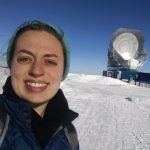
Dr. Amy Lowitz, my research partner and collaborator in Polar STEAM, was an incredible mentor to me, explaining all of the astronomy very clearly and in terms I could understand.
Core Arts Standards covered in this series of Lessons:
- Anchor Standard 1: Generate and conceptualize artistic ideas and work.
- Anchor Standard 2: Organize and develop artistic ideas and work.
- Anchor Standard 3: Refine and complete artistic work.
- Anchor Standard 5: Develop and refine artistic work for presentation.
- Anchor Standard 11: Relate artistic ideas and works with societal, cultural and historical context to deepen understanding.
Laurie Orth Music Teacher YouTube Channel: Please start this lesson series with the first video, Amy’s in Antarctica.
- Polar STEAM Amy’s in Antarctica: https://www.youtube.com/watch?v=kSDWSApCK2I
- Polar STEAM Baby Pictures of the Universe: https://www.youtube.com/watch?v=0xoo2J6XiYw
- Polar STEAM Earth Sized Telescope: https://www.youtube.com/watch?v=gF0IsJAXALc
- Polar STEAM Amy’s in Antarctica Bonus Feature: https://www.youtube.com/watch?v=qYLFjoCMvBg&t=2s
- Polar STEAM Music Files (Full demonstration and full accompaniment only of each song): https://www.youtube.com/watch?v=QrpETPgmyI8
Demonstration Files
Earth Sized Telescope:
Baby Pictures of the Universe:
Amy’s in Antarctic:
Accompaniment Music Files
Earth Sized Telescope:
Baby Pictures of the Universe:
Amy’s in Antarctic:
Standards:
Polar Literacy Principles:
New technologies, sensors and tools — as well as new applications of existing technologies — are expanding scientists’ abilities to study the land, ice, ocean, atmosphere and living creatures of the Polar Regions.
Resource Developed By

To learn more about this project
View Project


Made possible with funding by the U.S. National Science Foundation Award #2221990. The information contained here is those of the author(s) and does not necessarily reflect the views of the U.S. National Science Foundation.