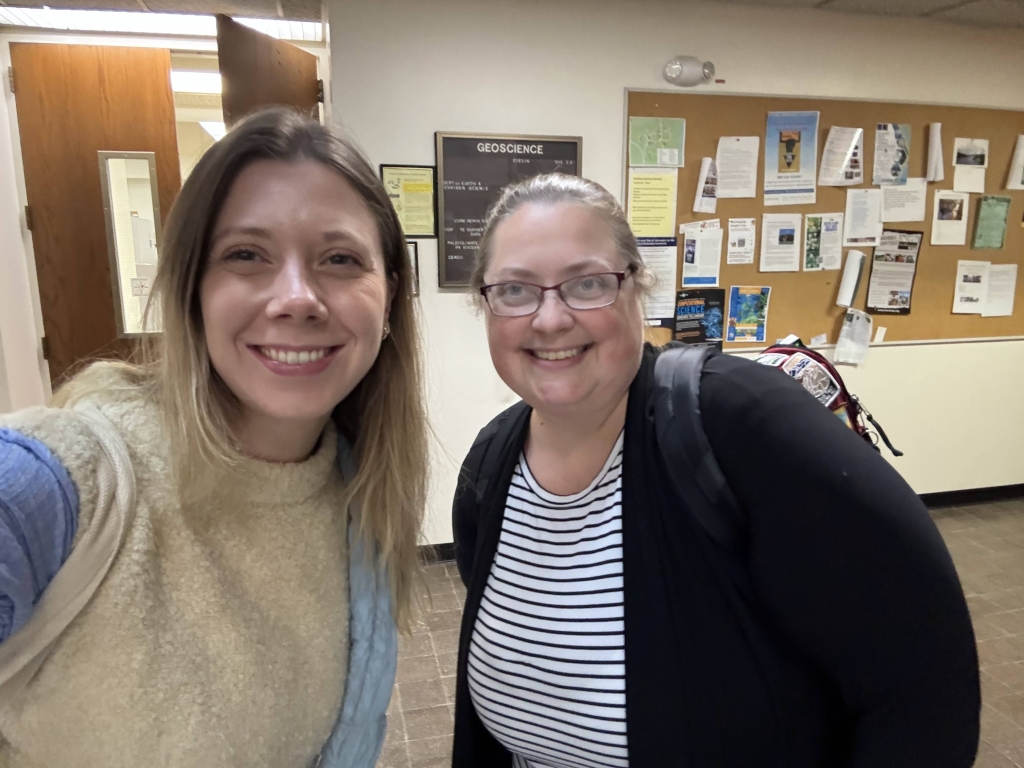

Tucked away in the woods of the Palisades, New York, sits a nondescript building that holds the memories of the planet. Stepping into the Lamont-Doherty Core Repository (LDEO) feels less like walking into a research facility and more like entering a subterranean library of Earth’s history. Row after row of floor-to-ceiling racks hold over 40 miles of ocean sediment cores – cylinders of mud, microfossils, and volcanic ash cored from ocean floors across the globe.
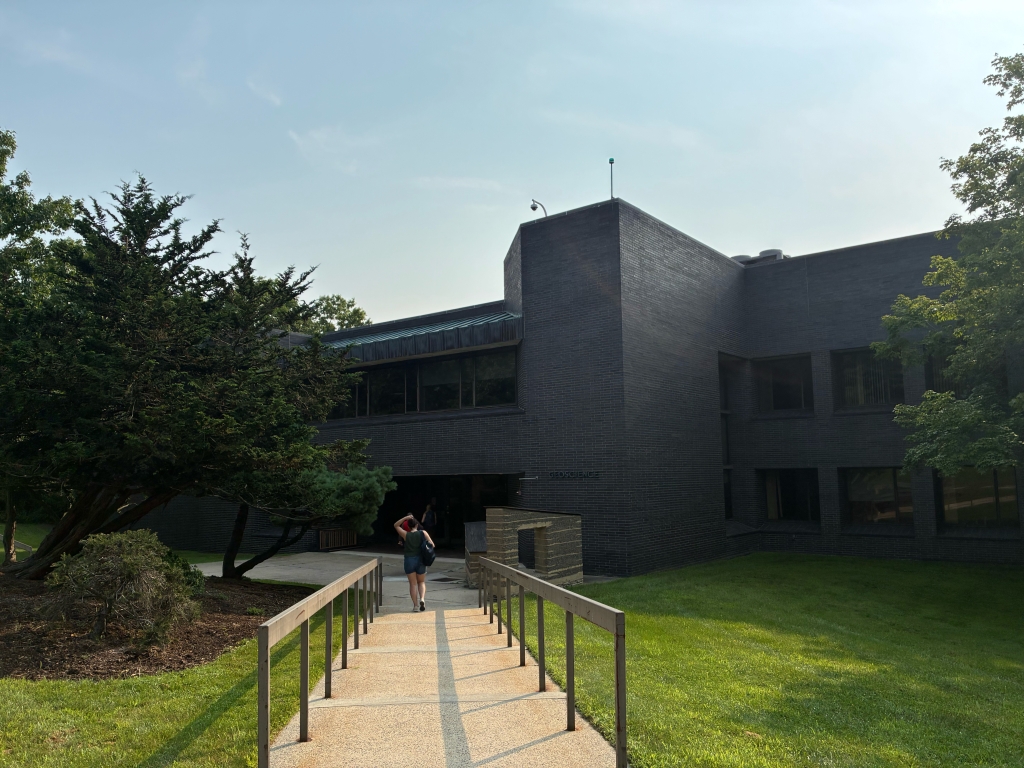
As a former field geologist, I’m used to reading Earth’s history with a rock hammer and a hand lens, standing in the open sky where the stratigraphy is written across the mountainsides, rock cuts, and cliff faces. I spent almost a decade with my boots on the ground: traversing outcrops, standing behind drill rigs, and mapping exposed rock. Standing in the LDEO climate-controlled stacks is a very different experience. My expertise had been in reading the Earth’s surface; the LDEO holds the ledger of Earth’s climate past. I recently got the chance to tour this unbelievable archive through my Polar STEAM virtual fellowship. Standing among tens of thousands of Earth’s hidden chapters made me realize how much of our story is packed into a few feet of deep-sea sediment.
The Lamont Geological Observatory, now known as the Lamont Doherty Earth Observatory (LDEO), was created in 1949 when the widow of Wall Street banker Thomas W. Lamont donated their Torrey Hill residence to Columbia University. The first sediment cores in the repository were collected in 1947 aboard the RV Atlantis, by Maurice Ewing, Lamont’s founder and first director. In those early days, cores were processed in Lamont’s former dining room under chandeliers, with the sediment chemically analyzed and treated using the family’s own dishware.
As Lamont’s geologists began to study the cores and the seafloor, they realized they needed a more efficient method for collecting data. This led to the design of the Ewing Piston Corer, which could collect seafloor sediment so quickly that a “one core a day” policy was enacted. The observatory rapidly needed more storage for cores, and an eight-car garage on the property was commandeered as the original core repository. Those original cores provided the critical basis for the theory of plate tectonics and the field of marine geology.
My research partner Joanna Davies is a postdoctoral research scientist at Lamont-Doherty Earth Observatory. Joanna’s current NSF-funded research project focuses on reconstructing freshwater export from the Arctic Ocean to the North Atlantic Ocean, to understand the impact on ocean circulation.
Every field geologist respects a hard-won sample, but few stories match the provenance of the Arctic’s T-3 cores. Joanna is currently working on a core retrieved in April 1974 from “Fletcher’s Ice Island” (T-3) in the Arctic Ocean. T-3 was a massive tabular floating iceberg that was used as a floating field station between 1952 and 1978. Many of the cores collected had no explicit purpose; now, 50 years later, the T-3 cores are being used to answer new questions in cutting-edge paleoclimate studies.
During our visit, Joanna took me through the process of collecting and analyzing samples of one of the sediment cores. Touching sediment thousands of years old and seeing those polar layers preserved firsthand gave me a new appreciation for marine geology. Deep-sea cores can contain material as old as 140 million years, providing valuable evidence to help scientists reconstruct past local and global climate conditions.
The legacy cores at Lamont are kept in dry storage. When the core was originally extracted in 1974, markers were placed along its entire 509-centimeter length at 10-centimeter intervals. However, over time, the intervals may have changed due to shrinking from water loss, storage conditions, or handling. Because of this sample intervals must be precisely rescaled.
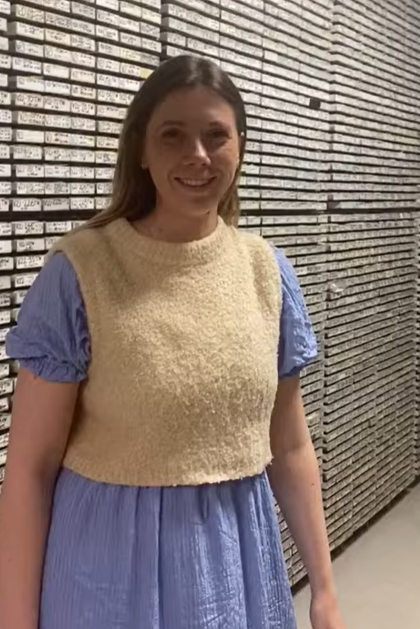
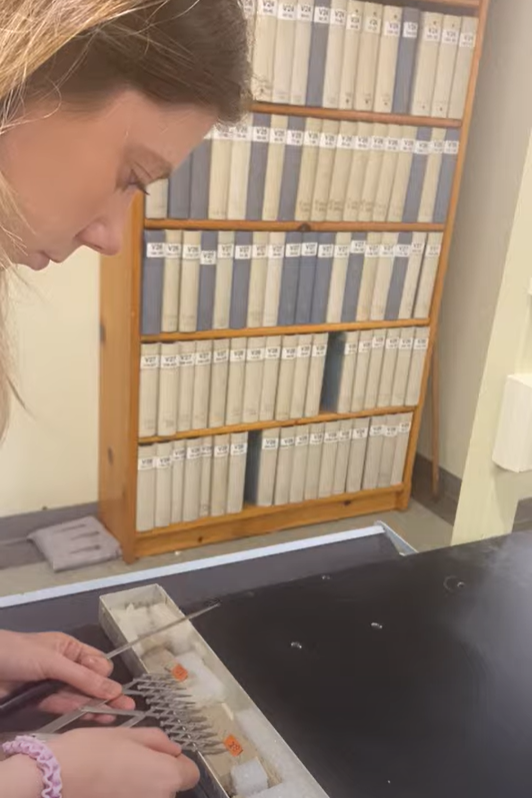
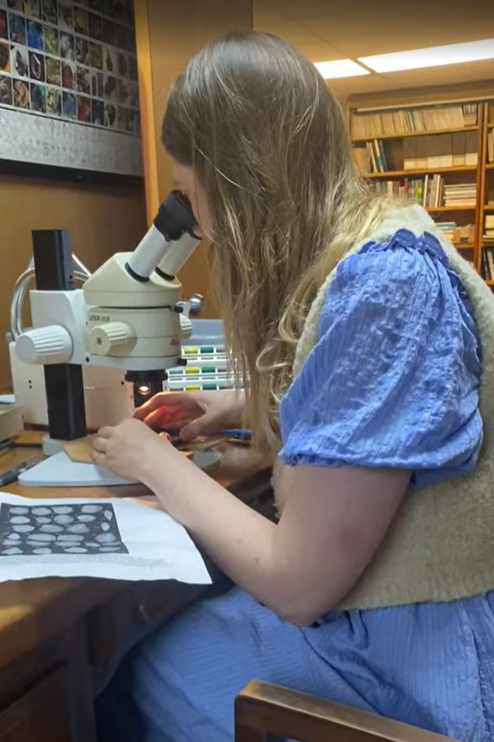
To collect a sample, Joanna selects a 1-2 centimeter interval of the core and isolates it using a pantograph scaling tool. The sample then heads to the rock-cutting room and is trimmed down to size and its mass collected. The sample is then placed in the disaggregator with some distilled water for at least 24 hours. The disaggregator will separate all the individual sediment grains, tectites, and microfossils. Specifically, Joanna is looking for the planktonic foraminifera trapped within the matrix.
Planktonic foraminifera (or forams) are tiny, single-celled organisms that live in the upper ocean. Their microscopic shells contain chemical clues about past ocean and climate conditions. The answer lies in isotopes—different forms of the same element that share the same number of protons but have varying mass numbers, due to a different number of neutrons in their nucleus. Some isotopes are stable, while others are radioactive, undergoing radioactive decay at a predictable rate. By studying these isotopes and their ratios, scientists can unlock secrets about the past climate, determine the age of ancient artifacts or the origins of unidentified human remains.
Joanna can measure the ratio of oxygen-18 to oxygen-16, known as δ¹⁸O, in these fossilized shells. The ratio of these two naturally occurring isotopes or “versions” of oxygen in these fossilized shells can help us learn about changes in past oceanic conditions, particularly temperature and the isotopic composition of seawater. This works because of isotope fractionation, a process where lighter isotopes (oxygen-16) evaporate more readily than heavier isotopes (oxygen-18) in the hydrologic cycle. The isotopic composition of water varies slightly from region to region based on temperature, distance from the ocean, and altitude, leading to distinct isotopic signatures.
During cold, glacial periods, large amounts of oxygen-16-rich water are stored as snow and ice on land in glaciers and ice sheets. This leaves the ocean relatively enriched in oxygen-18, which is incorporated into the shells of foraminifera as they grow. During warmer periods, melting of this land-based ice returns oxygen-16-rich freshwater to the ocean, lowering the δ¹⁸O of seawater. Changes in seawater δ¹⁸O recorded by foraminiferal shells can therefore provide evidence for past changes in ice volume and freshwater input, although ocean temperature and regional hydrological changes can also influence the signal. Joanna is currently separating these tiny organisms from sediment samples so that their shells can be analyzed for oxygen-18 and radiocarbon dating. The radiocarbon dates will help determine the ages of the samples and create an accurate timeline for interpreting the δ¹⁸O record.
Once the sample has been fully disaggregated, it is poured through a sieve to wash away the fine silt and segregate the forams. The sieve filters out the individual sediment grains and washes the foram samples. The isolated sample then goes into an oven to dry for another 24 hours.
Once dry, the sample is transferred into a vial and then poured into a picking tray on Joanna’s microscope, where she carefully sorts the microfossils using a fine paintbrush and picking needle. Under magnification, the forams appear as bright white, shell-like spheres against the surrounding material. Each foram is picked up and placed into a specialized gridded slide. To perform radiocarbon dating, Joanna needs a minimum of 8 micrograms of sample, which can require picking several thousand individual forams. The radiocarbon dating itself takes place at the Woods Hole Oceanographic Institute (WHOI) in Falmouth, Massachusetts. Because the testing process can several weeks, Joanna prepares and sends her samples in batches.
Collaborating with polar researchers builds a bridge between academia and public education. Students benefit by interacting with real-world datasets and simulated field research, while scientists gain new channels to share their discoveries with classrooms worldwide. If this visit taught me anything, it is that climate scientists are exceptionally systematic and patient. A single sediment sample could take several weeks from extraction in the core repository to final data analysis. Each step in the process must be executed with meticulous care; a single misstep can invalidate the entire dataset. Visiting Joanna’s lab re-energized me for the science we will conduct back in my classroom and opened countless new ways to bring cutting-edge climate research to life for my students.