

Summary
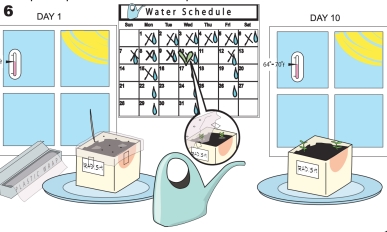
This resource provides three easy, hands-on activities that explore Arctic food systems, Food Life History and food sovereignty and can be done in an indoor, outdoor or classroom environment using recycled or inexpensive materials. The activities introduce concepts including germination, growing your own herbs and vegetables and small scale composting through vermicompost.
Two of the three resources are available in English and Spanish.
Materials and Preparation
Materials are listed on Page 1 of each activity.
Prior to the lesson, teachers should familiarize themselves with activity steps and materials. If teachers would like to do some additional background reading on Arctic plants and underground food storage practices, these resources provide excellent overviews.
Learning Objectives
Opening Activity
The hands-on nature of the activities will immediately engage students and challenge them to consider how the activity content connects with their own lives and communities. While students may not have a strong understanding of Arctic ecosystems and indigenous Food Life Histories, the students can build on their own communities’ relationships with land and food as a starting point and point of comparison. Students will access their prior knowledge through written reflection and facilitated group discussions.
Activity Overview
Activity Sheets:
- Arctic Loteria_English
- Buried Treasure_English
- Buried Treasure_Español
- Recipe Garden_English
- Recipe Garden_Español
Activity questions:
- “Arctic Lotería”: What plant did you find the most interesting, why? If you needed to gather four plants to feed you for a day, which ones would you gather? Why? Can you think of an example of a root, stem, leaf, flower and fruit that you eat? Are there any special recipes your family makes? What are the ingredients? What makes the recipe special or different?
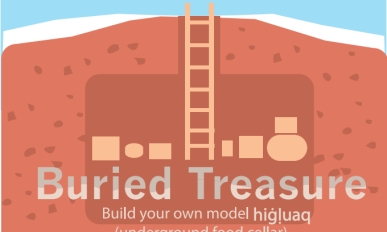
- “Buried Treasure”: How does your family store food? How is your food storage similar or different from a hiġỊuaq (hint: think about temperature and light exposure)? Think about a memorable meal you have eaten at home. What were the ingredients? Who helped make the meal? Why do you think that meal was so special? Imagine you live in Anaqtuuvak in modern times. What would be some of the benets of constructing a new hiġỊuaq? What would be some of the risks?
- “My Recipe Garden”: Which ingredients are fruits, vegetables or herbs? Which ingredients could be grown in a garden? Which would you buy at a store? Do your ingredients include roots, stems, leaves, flowers, fruits or seeds?
The extension activities and reflection questions on Page 2 of each activity sheet will help students synthesize their learning. The hands-on component of each activity will also provide an opportunity for students to demonstrate mastery.
Students can work in groups on the hands-on components of the activities in order to provide feedback and improve one another’s designs.
Reflection
Students can further reflect on what they learned through continued exploration of the garden and underground cellar models they create and through additional study of the lotería cards. Students will also complete additional reflections through comparisons with local food systems, family food practices and histories, group discussions and journaling.
Learning objectives are met through successful completion of hands-on model components of each activity.
Supporting Documents
Common Core Standards
- Reading: RI.6-12.2, RI.6-12.5, RI.6-12.7,
- Writing: W.6-12.4
- Speaking and Listening: SL.6-12.1, SL.6-12.2
- Language: L.6-12.1, L.6-12.2, L.6-12.4
- History: H.6.1, H.8.5, H.11.4, H.11.11, H.12.3,
- Mathematics: 3-5.MD.2, 6-12.G.1, 6-12.G.2, 6-12.G.3, 6-12.G.4
Next Generation Science Standards
MS-LS1-6, MS-LS1-7, MS-LS2-1, MS-LS2-3, MS-LS2-5, MS-ESS3-4, HS-LS2-4, HS-ETS1-1
Additional Background Resources:
Students can build their understanding and broaden their thinking through the book recommendation, Eagle Drums by Nasuġraq Rainey Hopson.
Students can also learn more about the Nunamiut people of Anaktuvuk Pass through the North Slope Borough website: https://www.north-slope.org/our-communities/anaktuvuk-pass/ or the writings of Simon Paneak: https://www.google.com/books/edition/In_a_Hungry_Country/Jz8rAQAAIAAJ?hl=en&gbpv=1&bsq=inauthor:%22Simon+Paneak%22&dq=inauthor:%22Simon+Paneak%22&printsec=frontcover
References:
This activity was created through a Polar STEAM partnership between Meghan Nealon, Yoko Kugo, and Michael Koskey (research team), GrowingGreat, and the Anaktuvuk Pass community.
“Arctic Lotería” sources include Gladys Mekiana, Anaktuvuk Pass resident; Official Website of the North Slope Borough; NSB Arctic Harvest project; North Slope Iñupiaq to English Dictionary.
Special thanks to the K-12 students in Anaktuvuk Pass who assisted in piloting the “Buried Treasure” activity and to Yoko Kugo for the original concept design and Anaktuvuk Pass residents and elders who provided insight into cellar use and design.
NGSS Science Standards:
Polar Literacy Principles:
Humans are a part of the Polar system. The Arctic has a rich cultural history and diversity of Indigenous Peoples.
Explore more lessons in this unit!
Resource Developed By
To learn more about this project
View Project

Made possible with funding by the U.S. National Science Foundation Award #2221990. The information contained here is those of the author(s) and does not necessarily reflect the views of the U.S. National Science Foundation.