

Pace of Life Syndrome in an Arctic Hibernator
Life-history theory posits that energetic limitations combined with costs of reproduction impose a trade-off between allocation to current and future reproduction, resulting in the evolution of animal life histories along a ‘fast-slow’ continuum. Mean age at reproductive maturity reflects the position of a species along the fast-slow continuum: fast species mature quickly whereas slow species mature later in life. Considerable intraspecific variation in age at maturity also exists and explaining the source of this variation is a key goal of evolutionary ecology. This study is designed to test two hypotheses to explain why some male Arctic ground squirrels mature and reproduce at age one, whereas others defer reproductive maturity until age two. The pace-of-life syndrome (POLS) hypothesis proposes that intraspecific variation in age at maturation might be explained by different allocation strategies among individual squirrels that fall along the fast-slow continuum and manifest in consistent differences in behavior and physiology among the individuals. The alternative hypothesis suggests that intraspecific variation in age at maturity in squirrels may instead be the outcome of among-individual variation in food acquisition and associated condition.
Participants Involved in This Project

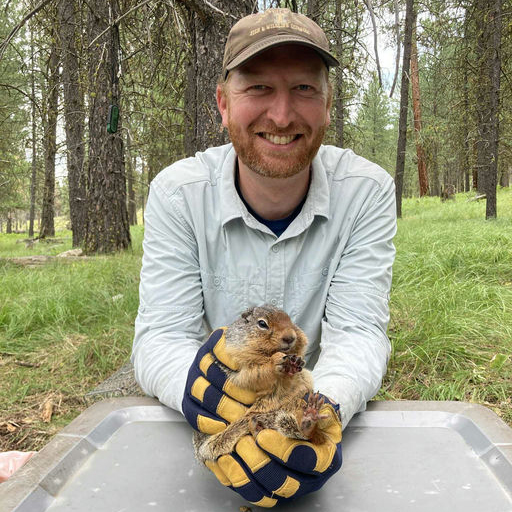
Austin Allison | Researcher Fellow



Made possible with funding by the U.S. National Science Foundation Award #2221990. The information contained here is those of the author(s) and does not necessarily reflect the views of the U.S. National Science Foundation.